
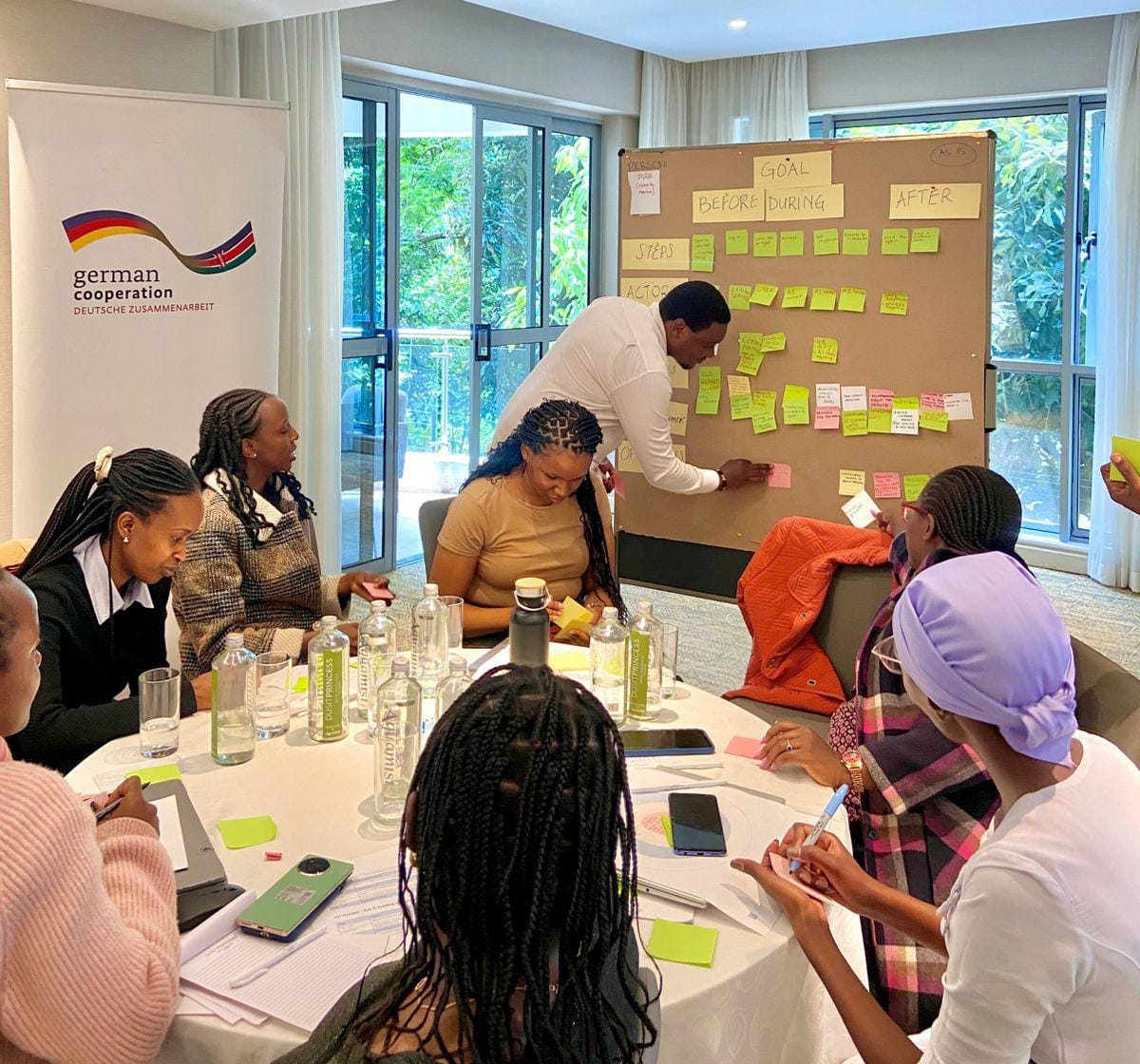
Knowledge from the GovStack Women training workshop in Nairobi, facilitated by Michelle Sahal Estimé
Public services touch people’s lives daily, whether they are accessing healthcare, applying for documents, seeking support, or simply moving through civic systems. Yet too often, these services are shaped around policies, technology, or assumptions about a “typical user,” instead of the full range of real human experiences.
A recent workshop on service design offered a powerful reminder of what can happen when we flip that script and start with people first.
Understanding Service Design: Starting With Real Experiences
Instead of asking “What does the system currently do?” the conversation shifted to “What do people actually experience?”
We explored how public services can be redesigned not by adding more forms or technology but by understanding the lived journeys of those who use (or struggle to use) these services. Key areas included:
- Mapping real user experiences
- Identifying pain points that policies often overlook
- Visualizing how a service flows from a person’s perspective
- Highlighting emotional, social, and cultural factors that shape interactions
This foundation set the stage for a deeper exploration: how inclusive design can address gendered, structural, and systemic barriers.
Bringing Inclusion to the Core: Gender-Sensitive and Ethical Design
The next part of the workshop dove into gender-sensitive and inclusive design, an area where traditional service design tools can be significantly strengthened.
We used a combination of service design and ethical design tools, including:
- As-Is Journey Mapping: Understanding the current user experience, step by step.
- To-Be Journey Mapping: Reimagining what a better, more inclusive experience could look like.
- Reversed Stakeholder Mapping: Looking beyond the usual power players to identify those who are invisible, marginalized, or excluded in decision-making processes.
- Minority Personas: Crafting personas based on individuals who are often overlooked, those who face barriers due to gender, disability, socioeconomic background, or cultural norms.
These tools pushed us to slow down, listen deeply, and consider perspectives that rarely make it into policy documents or system designs.
The Transformative Moment: Seeing Who’s Missing
The highlight of the workshop came when each group experienced a collective “aha” moment.
One by one, teams realized a simple but powerful truth:
When we notice who is usually left outside and intentionally design for them, we don’t just help them; we end up solving challenges for everyone.
This is because focusing on those who are typically excluded often provides the clearest path to solving challenges for everyone, especially in product and system design.
Examples shared included:
- Addressing safety concerns from a gender perspective improved service navigation for all users.
- Designing communication for low-literacy groups made processes clearer for everyone.
- Considering the mobility challenges of minority personas led to simpler, more efficient workflows that benefitted all.
Inclusion shifted from focusing on isolated issues to prioritizing universal improvements.
Why This Matters for Public Service Transformation
Service design becomes transformative when it challenges assumptions, surfaces hidden barriers, and acknowledges the diversity of real people using public systems.
Gender-sensitive and ethical design are not add-ons; they are essential to ensuring that services:
- Respect the complexities of people’s lives
- Prioritize dignity and accessibility
- Reduce unintentional harm
- Improve efficiency by reducing repeated errors and bottlenecks
- Help governments and organizations serve communities more effectively
When we widen our view to include those often overlooked, public services become fairer, kinder, and more effective for everyone.
This workshop was a reminder that the heart of good service design is empathy coupled with action. Inclusive design isn’t just a moral imperative; it is a practical pathway to better systems.
When we identify who has been excluded and deliberately designed out, we uncover solutions with the power to transform entire services and uplift entire communities.